The Criticism Letter for Policy Issues serves as a formal avenue for addressing concerns regarding specific policies that may have negative implications for stakeholders. Through clear and constructive feedback, this letter aims to foster dialogue and encourage positive changes that align with the values and needs of the community affected by these policies.
Criticism Letter for Policy Issues
Looking for more examples like this? Explore the Criticism Letters for additional letter templates and guidance.
What Is a Criticism Letter for Policy Issues?
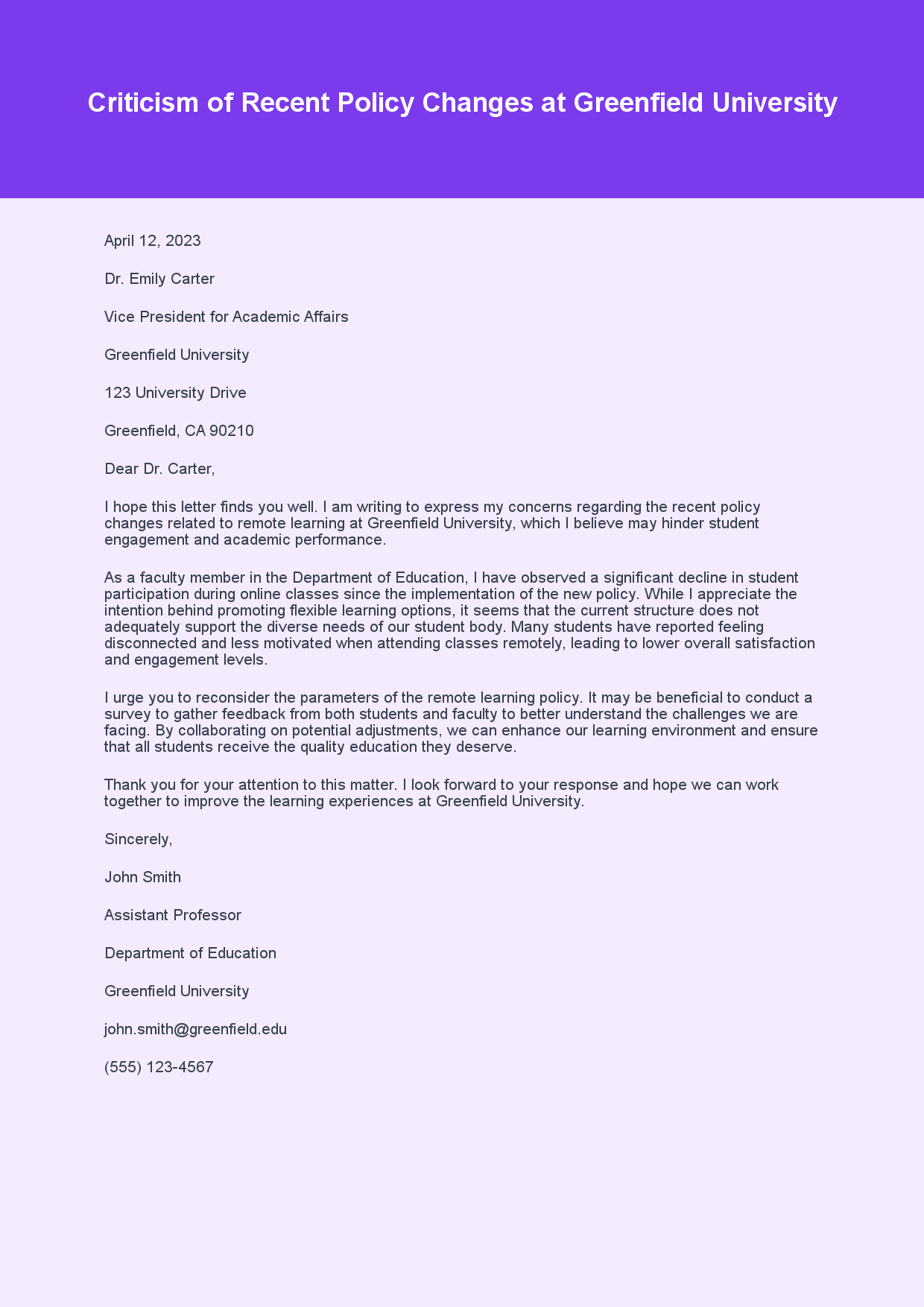
A Criticism Letter for Policy Issues is a formal communication that addresses concerns or objections regarding specific policies implemented by an organization, government, or institution. This type of letter typically articulates the writer's perspective on how certain policies may negatively impact stakeholders, the community, or the organization's objectives.
In crafting such a letter, it is crucial to present a well-reasoned argument supported by facts and examples, while maintaining a respectful tone. The goal is not only to express dissent but also to encourage dialogue and potential reconsideration of the policy in question, fostering a constructive exchange of ideas on how to improve or revise the existing framework.
Purpose & Importance of Criticism Letter for Policy Issues
A Criticism Letter for Policy Issues addresses concerns regarding specific policies, aiming to prompt dialogue and potential revisions for improvement.
- Clarity: Clearly articulate the specific policy issue being criticized.
- Evidence: Provide data or examples to support your criticism and strengthen your argument.
- Impact: Explain how the policy negatively affects stakeholders or the community at large.
- Suggestions: Offer constructive alternatives or solutions to the identified issues.
- Call to Action: Encourage the recipient to engage in further discussion or review of the policy.
When Should You Write a Criticism Letter for Policy Issues ?
- Unfair Workplace Policies - When an organization implements policies that disproportionately affect certain groups of employees, a criticism letter can highlight the inequity and urge a review of these policies to promote fairness and inclusivity.
- Environmental Concerns - If a company adopts practices that harm the environment, a criticism letter can address these issues, advocate for sustainable practices, and encourage the organization to adopt more environmentally-friendly policies.
- Discriminatory Practices - In situations where company policies lead to discrimination based on race, gender, or other protected characteristics, a letter can call for a reevaluation and reform of these policies to ensure compliance with anti-discrimination laws.
- Inadequate Health and Safety Regulations - Employees may write a criticism letter if workplace health and safety regulations are insufficient, urging management to prioritize employee well-being and adhere to legal safety standards.
- Unclear Communication Policies - When communication policies lead to confusion or misinformation among employees, a criticism letter can highlight the need for clearer guidelines and more effective communication strategies.
- Excessive Surveillance Policies - If an organization implements invasive surveillance measures that undermine employee privacy, a criticism letter can challenge these practices and advocate for a balance between security and privacy rights.
- Unjust Disciplinary Actions - Employees may feel compelled to write a criticism letter in response to disciplinary actions that seem unjust or arbitrary, seeking to bring attention to the need for fair treatment and transparent procedures.
- Lack of Support for Mental Health - When a company fails to provide adequate mental health support and resources for employees, a criticism letter can address this gap and advocate for policies that support mental well-being in the workplace.
Format of a Criticism Letter for Policy Issues
A Criticism Letter for Policy Issues should be structured in a clear and concise manner to effectively communicate your concerns. Below is a recommended structure that will help ensure your message is well-received and understood.
- Salutation
Begin with a formal greeting. Address the recipient by name if possible, using their proper title (e.g., Dear Mr./Ms./Dr.). If the specific person is unknown, a general greeting such as "To Whom It May Concern" is acceptable.
- Introduction
Introduce yourself and briefly state the purpose of the letter. Make it clear that you are writing to express your concerns regarding specific policy issues. Aim for a respectful tone while highlighting the significance of the matter.
- Statement of the Issue
Clearly outline the specific policy issue you are criticizing. Provide relevant context and background information to ensure the reader understands the situation. Use factual data and examples to support your claims.
- Impact of the Policy
Discuss the consequences of the current policy or proposed changes. Explain how it affects stakeholders, including individuals, communities, or organizations. Use concrete examples to illustrate the impact.
- Alternative Solutions
Offer constructive criticism by suggesting alternative approaches or solutions that could address the issue more effectively. Provide reasoning for why these alternatives would be beneficial.
- Call to Action
Encourage the recipient to take specific actions regarding the policy issue. Whether it’s conducting further research, considering your suggestions, or engaging with affected stakeholders, make your desired outcome clear.
- Closing Statement
Reiterate your appreciation for the recipient's attention to the matter and express your hope for a positive outcome. End with a courteous closing statement.
- Signature
Sign off with your name and, if applicable, your position or affiliation. Include your contact information for any follow-up communication.
Sample Criticism Letter for Policy Issues
Explore five complete scenarios with fully written letters you can adapt immediately.
Criticism Letter for Policy Issues - Sample 1
Concerns regarding the new remote learning policy impacting student engagement.
April 12, 2023
Dr. Emily Carter
Vice President for Academic Affairs
Greenfield University
123 University Drive
Greenfield, CA 90210
Dear Dr. Carter,
I hope this letter finds you well. I am writing to express my concerns regarding the recent policy changes related to remote learning at Greenfield University, which I believe may hinder student engagement and academic performance.
As a faculty member in the Department of Education, I have observed a significant decline in student participation during online classes since the implementation of the new policy. While I appreciate the intention behind promoting flexible learning options, it seems that the current structure does not adequately support the diverse needs of our student body. Many students have reported feeling disconnected and less motivated when attending classes remotely, leading to lower overall satisfaction and engagement levels.
I urge you to reconsider the parameters of the remote learning policy. It may be beneficial to conduct a survey to gather feedback from both students and faculty to better understand the challenges we are facing. By collaborating on potential adjustments, we can enhance our learning environment and ensure that all students receive the quality education they deserve.
Thank you for your attention to this matter. I look forward to your response and hope we can work together to improve the learning experiences at Greenfield University.
Sincerely,
John Smith
Assistant Professor
Department of Education
Greenfield University
[email protected]
(555) 123-4567
Dr. Emily Carter
Vice President for Academic Affairs
Greenfield University
123 University Drive
Greenfield, CA 90210
Dear Dr. Carter,
I hope this letter finds you well. I am writing to express my concerns regarding the recent policy changes related to remote learning at Greenfield University, which I believe may hinder student engagement and academic performance.
As a faculty member in the Department of Education, I have observed a significant decline in student participation during online classes since the implementation of the new policy. While I appreciate the intention behind promoting flexible learning options, it seems that the current structure does not adequately support the diverse needs of our student body. Many students have reported feeling disconnected and less motivated when attending classes remotely, leading to lower overall satisfaction and engagement levels.
I urge you to reconsider the parameters of the remote learning policy. It may be beneficial to conduct a survey to gather feedback from both students and faculty to better understand the challenges we are facing. By collaborating on potential adjustments, we can enhance our learning environment and ensure that all students receive the quality education they deserve.
Thank you for your attention to this matter. I look forward to your response and hope we can work together to improve the learning experiences at Greenfield University.
Sincerely,
John Smith
Assistant Professor
Department of Education
Greenfield University
[email protected]
(555) 123-4567
Download this letter in:
Criticism Letter for Policy Issues - Sample 2
A recent shift in remote work policy has caused employee dissatisfaction.
March 15, 2023
Johnathan Smith
Director of Human Resources
TechForward Inc.
123 Innovation Drive
Tech City, CA 90210
Sarah Johnson
Employee Relations Committee Chair
TechForward Inc.
123 Innovation Drive
Tech City, CA 90210
Dear Ms. Johnson,
I hope this message finds you well. I am writing to formally express my concerns regarding the recent changes to our remote work policy that were communicated to all employees last month. While I understand the need for adaptability in our work environment, I believe the current policy does not align with the best interests of our team or the company's long-term goals.
The decision to limit remote work options has led to considerable dissatisfaction among many employees, as it significantly disrupts our work-life balance. Numerous team members have expressed their frustrations, indicating that the new policy may adversely affect morale and productivity. I believe it is crucial that we consider the implications of these changes not only on employee satisfaction but also on retention rates in a competitive job market.
I propose that we revisit this policy in a collaborative manner, involving input from various departments to ensure that any new guidelines reflect the needs and preferences of our workforce. Open dialogue can lead to creative solutions that maintain operational efficiency while also supporting employee well-being.
Thank you for considering my concerns. I look forward to discussing this matter further and working together to find a resolution that benefits everyone involved.
Sincerely,
Johnathan Smith
Director of Human Resources
TechForward Inc.
Johnathan Smith
Director of Human Resources
TechForward Inc.
123 Innovation Drive
Tech City, CA 90210
Sarah Johnson
Employee Relations Committee Chair
TechForward Inc.
123 Innovation Drive
Tech City, CA 90210
Dear Ms. Johnson,
I hope this message finds you well. I am writing to formally express my concerns regarding the recent changes to our remote work policy that were communicated to all employees last month. While I understand the need for adaptability in our work environment, I believe the current policy does not align with the best interests of our team or the company's long-term goals.
The decision to limit remote work options has led to considerable dissatisfaction among many employees, as it significantly disrupts our work-life balance. Numerous team members have expressed their frustrations, indicating that the new policy may adversely affect morale and productivity. I believe it is crucial that we consider the implications of these changes not only on employee satisfaction but also on retention rates in a competitive job market.
I propose that we revisit this policy in a collaborative manner, involving input from various departments to ensure that any new guidelines reflect the needs and preferences of our workforce. Open dialogue can lead to creative solutions that maintain operational efficiency while also supporting employee well-being.
Thank you for considering my concerns. I look forward to discussing this matter further and working together to find a resolution that benefits everyone involved.
Sincerely,
Johnathan Smith
Director of Human Resources
TechForward Inc.
Download this letter in:
Criticism Letter for Policy Issues - Sample 3
The letter addresses issues with a newly implemented attendance policy.
March 15, 2023
Dr. Emily Thompson
Vice President of Academic Affairs
Greenfield University
123 Academic Way
Greenfield, CA 90210
Dear Dr. Thompson,
I hope this message finds you well. I am writing to express my concerns regarding the recently implemented attendance policy, which I believe poses significant challenges for both students and faculty alike.
While I understand the intent behind encouraging student attendance, the stringent nature of the new policy may inadvertently create undue stress for those facing personal or health-related challenges. Several students have approached me with their apprehensions about the inflexible attendance requirements, which could ultimately impact their academic performance and mental well-being.
Furthermore, the policy lacks provisions for students who may be participating in legitimate extracurricular activities or internships that are integral to their professional development. An inclusive approach that accommodates such scenarios would not only enhance student satisfaction but also align with the university's commitment to fostering a supportive educational environment.
I urge you to consider revisiting this policy in consultation with both faculty and students to ensure it reflects the diverse needs of our university community. Thank you for considering my feedback on this important matter.
Sincerely,
James H. Parker
Professor of Sociology
Greenfield University
456 Faculty Lane
Greenfield, CA 90210
Dr. Emily Thompson
Vice President of Academic Affairs
Greenfield University
123 Academic Way
Greenfield, CA 90210
Dear Dr. Thompson,
I hope this message finds you well. I am writing to express my concerns regarding the recently implemented attendance policy, which I believe poses significant challenges for both students and faculty alike.
While I understand the intent behind encouraging student attendance, the stringent nature of the new policy may inadvertently create undue stress for those facing personal or health-related challenges. Several students have approached me with their apprehensions about the inflexible attendance requirements, which could ultimately impact their academic performance and mental well-being.
Furthermore, the policy lacks provisions for students who may be participating in legitimate extracurricular activities or internships that are integral to their professional development. An inclusive approach that accommodates such scenarios would not only enhance student satisfaction but also align with the university's commitment to fostering a supportive educational environment.
I urge you to consider revisiting this policy in consultation with both faculty and students to ensure it reflects the diverse needs of our university community. Thank you for considering my feedback on this important matter.
Sincerely,
James H. Parker
Professor of Sociology
Greenfield University
456 Faculty Lane
Greenfield, CA 90210
Download this letter in:
Criticism Letter for Policy Issues - Sample 4
The company has implemented a new policy that reduces healthcare benefits, affecting employee morale.
October 15, 2023
Jessica Thompson
Director of Human Resources
Innovative Solutions Inc.
123 Business Rd.
Suite 400
New York, NY 10001
Mr. Alan Carter
Chief Executive Officer
Innovative Solutions Inc.
123 Business Rd.
Suite 400
New York, NY 10001
Dear Mr. Carter,
I am writing to express my concerns regarding the recent changes to our employee healthcare benefits policy, which were announced on October 1, 2023. While I understand the need for the company to make adjustments to maintain financial stability, I believe that the implications of these changes warrant further discussion.
The reduction in coverage, particularly in mental health services and preventive care, has raised significant concerns among our employees. Many team members have expressed feelings of uncertainty and anxiety about their health coverage moving forward. As you know, a healthy workforce is crucial for our company’s success, and maintaining robust healthcare benefits is essential for employee satisfaction and retention.
I urge you to reconsider the specifics of the new policy or, at the very least, to engage in a dialogue with employees to gather their feedback. Open communication can often lead to solutions that address both the company’s financial needs and the well-being of our employees.
Thank you for considering my perspective on this important issue. I look forward to your response and hope we can work together towards a resolution that supports both the company and its employees.
Sincerely,
Jessica Thompson
Director of Human Resources
Innovative Solutions Inc.
Jessica Thompson
Director of Human Resources
Innovative Solutions Inc.
123 Business Rd.
Suite 400
New York, NY 10001
Mr. Alan Carter
Chief Executive Officer
Innovative Solutions Inc.
123 Business Rd.
Suite 400
New York, NY 10001
Dear Mr. Carter,
I am writing to express my concerns regarding the recent changes to our employee healthcare benefits policy, which were announced on October 1, 2023. While I understand the need for the company to make adjustments to maintain financial stability, I believe that the implications of these changes warrant further discussion.
The reduction in coverage, particularly in mental health services and preventive care, has raised significant concerns among our employees. Many team members have expressed feelings of uncertainty and anxiety about their health coverage moving forward. As you know, a healthy workforce is crucial for our company’s success, and maintaining robust healthcare benefits is essential for employee satisfaction and retention.
I urge you to reconsider the specifics of the new policy or, at the very least, to engage in a dialogue with employees to gather their feedback. Open communication can often lead to solutions that address both the company’s financial needs and the well-being of our employees.
Thank you for considering my perspective on this important issue. I look forward to your response and hope we can work together towards a resolution that supports both the company and its employees.
Sincerely,
Jessica Thompson
Director of Human Resources
Innovative Solutions Inc.
Download this letter in:
Criticism Letter for Policy Issues - Sample 5
A university professor expresses concerns about a new grading policy's impact on student performance.
March 15, 2023
Dr. Sarah Whittaker
Department of Education
Greenfield University
123 Academic Way
Greenfield, CA 90210
Dr. James Thompson
Dean of Academic Affairs
Greenfield University
123 Academic Way
Greenfield, CA 90210
Dear Dr. Thompson,
I hope this letter finds you well. I am writing to formally express my concerns regarding the recent changes to the grading policy implemented at Greenfield University. While I understand the intention behind these modifications is to enhance educational outcomes, I believe that the current approach may inadvertently hinder student performance and engagement.
The new policy, which emphasizes a strict curve in grading, has created an environment of heightened competition among students. Rather than fostering collaboration and a love for learning, this approach appears to encourage students to focus solely on grades, potentially at the expense of their overall educational experience. As an educator, I have witnessed firsthand how this shift has impacted students’ morale and their willingness to participate in class discussions.
Moreover, I am concerned that this policy disproportionately affects students who may already be at a disadvantage. Those who require additional support to grasp complex concepts may find themselves demotivated, leading to a cycle of underperformance. It is crucial that we create a learning environment that is inclusive and equitable for all students, and I fear that the current grading policy may be counterproductive in achieving this goal.
I urge you to reconsider this policy and explore alternatives that prioritize student learning and development over competition. I would appreciate the opportunity to discuss this matter further and collaborate on finding a solution that benefits our students and upholds the integrity of our academic standards.
Thank you for your attention to this important issue. I look forward to your response.
Sincerely,
Dr. Sarah Whittaker
Professor, Department of Education
Greenfield University
Dr. Sarah Whittaker
Department of Education
Greenfield University
123 Academic Way
Greenfield, CA 90210
Dr. James Thompson
Dean of Academic Affairs
Greenfield University
123 Academic Way
Greenfield, CA 90210
Dear Dr. Thompson,
I hope this letter finds you well. I am writing to formally express my concerns regarding the recent changes to the grading policy implemented at Greenfield University. While I understand the intention behind these modifications is to enhance educational outcomes, I believe that the current approach may inadvertently hinder student performance and engagement.
The new policy, which emphasizes a strict curve in grading, has created an environment of heightened competition among students. Rather than fostering collaboration and a love for learning, this approach appears to encourage students to focus solely on grades, potentially at the expense of their overall educational experience. As an educator, I have witnessed firsthand how this shift has impacted students’ morale and their willingness to participate in class discussions.
Moreover, I am concerned that this policy disproportionately affects students who may already be at a disadvantage. Those who require additional support to grasp complex concepts may find themselves demotivated, leading to a cycle of underperformance. It is crucial that we create a learning environment that is inclusive and equitable for all students, and I fear that the current grading policy may be counterproductive in achieving this goal.
I urge you to reconsider this policy and explore alternatives that prioritize student learning and development over competition. I would appreciate the opportunity to discuss this matter further and collaborate on finding a solution that benefits our students and upholds the integrity of our academic standards.
Thank you for your attention to this important issue. I look forward to your response.
Sincerely,
Dr. Sarah Whittaker
Professor, Department of Education
Greenfield University
Download this letter in:
Tips to Write an Effective Criticism Letter for Policy Issues
- Be Clear: State your main point in the opening sentence to grab attention.
- Stay Professional: Maintain a respectful tone, even when expressing strong disagreement.
- Use Facts: Support your arguments with data and evidence to enhance credibility.
- Be Specific: Identify specific policies or actions you are criticizing to avoid vagueness.
- Offer Alternatives: Suggest constructive solutions or improvements instead of just pointing out flaws.
- Know Your Audience: Tailor your language and content to resonate with the recipient's perspective.
- Limit Length: Keep the letter concise—aim for one page to ensure it is read in full.
- Use Bullet Points: Break down complex information with bullet points for easy readability.
- Include Personal Experience: Share relevant personal anecdotes to humanize your criticism.
- Proofread: Check for grammar and spelling errors to maintain professionalism.
- Be Timely: Address current issues promptly to ensure relevance.
- Call to Action: End with a clear request or action you want the recipient to take.
- Stay Positive: Frame criticism in a way that encourages dialogue and improvement.
- Use a Strong Closing: Reinforce your main message and thank the recipient for their time.
- Follow Up: Consider following up after sending the letter to show your commitment to the issue.
Common Mistakes to Avoid in Criticism Letter for Policy Issues
- Lack of Clarity: Failing to clearly articulate the specific policy issue being criticized can lead to confusion and dilute the impact of the letter.
- Emotional Language: Using overly emotional or inflammatory language can undermine the credibility of the criticism and alienate the intended audience.
- Insufficient Evidence: Not providing adequate evidence or examples to support the criticism weakens the argument and may lead to dismissal of the concerns raised.
- Ignoring Solutions: Focusing solely on the criticism without suggesting constructive alternatives can make the letter seem negative and unproductive.
- Overly Lengthy: Writing a letter that is too long can overwhelm the reader; being concise ensures that key points are communicated effectively.
- Neglecting Tone: A tone that is overly aggressive or condescending can alienate the recipient; maintaining a respectful tone is crucial for productive dialogue.
- Failure to Proofread: Spelling and grammatical errors can detract from the professionalism of the letter and distract from the main message.
- Not Addressing the Right Audience: Sending the letter to the wrong individual or group can result in it being ignored, so it's important to ensure it reaches the appropriate decision-makers.
Subject Line Examples for Criticism Letter for Policy Issues
- Your voice matters: Addressing policy concerns through criticism
- Join the conversation: Share your thoughts on critical policy issues
- Important: We need your feedback on our policy approach
- Let’s talk: Your insights on policy issues are crucial
- Speak up: Help us improve our policies with your feedback
- We value your opinion: Critique our current policy initiatives
- Have your say: Contributing to policy improvement
- Your perspective on policy issues is needed!
- Help us shape our policies: Submit your criticism
- Engage with us: Share your views on pressing policy matters
- We’re listening: Provide your feedback on policy challenges
- Take action: Influence policy change with your insights
- Your criticism can lead to meaningful policy change
- Let’s collaborate: Discussing the impact of policy issues
- Join us in refining our policies: Submit your input
- Help us grow: Your critical feedback on policy is essential
Useful Phrases & Lines for Criticism Letter for Policy Issues
Opening Lines
- I am writing to express my concerns regarding the recent policy changes implemented by your organization.
- It has come to my attention that certain aspects of the policy may have unintended negative consequences.
- As a stakeholder, I feel it is important to address these issues for the betterment of our community.
- I appreciate the efforts made to improve our systems, but I believe there are areas that warrant further scrutiny.
Body Lines
- The recent policy on [specific issue] appears to overlook critical factors such as [specific concern].
- Many individuals affected by this policy have expressed their dissatisfaction, citing [examples of feedback].
- Moreover, the implementation timeline seems unrealistic and may lead to confusion and frustration among staff and stakeholders.
- It is essential to consider the long-term implications of these policy changes, particularly regarding [specific area].
- I urge you to revisit this policy and engage in a dialogue with those impacted to find a more equitable solution.
Closing Lines
- Thank you for your attention to this matter; I hope my feedback will be taken into consideration.
- I look forward to seeing a thoughtful response to these concerns and the opportunity for further discussion.
- Please feel free to reach out if you would like to discuss this matter in detail.
- Together, we can work towards policies that truly benefit our community and organization.
FAQs about Criticism Letter for Policy Issues
- What is a Criticism Letter for Policy Issues?
A Criticism Letter for Policy Issues is a formal communication addressing specific concerns or shortcomings in existing policies. It aims to highlight issues and suggest improvements to ensure policies are effective, fair, and aligned with the organization's goals and values.
- What should be included in a Criticism Letter?
A well-structured Criticism Letter should include a clear subject line, an introduction stating the purpose, specific examples of the policy issues, constructive criticism, and proposed solutions. Additionally, a respectful tone and a call to action are essential for effective communication.
- How do I ensure my criticism is constructive?
To ensure constructive criticism, focus on specific issues rather than personal attacks. Use objective language, provide evidence to support your claims, and suggest practical solutions. This approach fosters a collaborative environment, encouraging positive change rather than defensiveness.
- Who should receive the Criticism Letter?
The Criticism Letter should be addressed to the individual or group responsible for the policy in question. This could include management, a specific department, or a policy-making body. Ensure that the letter reaches the appropriate decision-makers to facilitate necessary changes.
- What tone should I use in the letter?
The tone of the letter should be professional, respectful, and diplomatic. While it’s important to express concerns clearly, maintaining a constructive tone helps to foster dialogue and encourages a more receptive response from the recipients.
- Can a Criticism Letter lead to actual policy changes?
Yes, a well-articulated Criticism Letter can effectively prompt policy evaluation and potential changes. By clearly outlining issues and providing thoughtful suggestions, you can influence decision-makers and contribute to the improvement of policies within the organization.
In conclusion, embracing the guidance provided for crafting your Criticism Letter for Policy Issues will empower you to articulate your concerns effectively and influence meaningful change. By following these strategies, you can ensure your message is not only heard but also taken seriously by decision-makers. Take this opportunity to advocate for the policies that matter to you, and don’t hesitate to make your voice count in the conversation. Start drafting your letter today—your insights have the potential to drive impactful dialogue and foster progress.