The Evaluation Letter for Employee Assessment is a crucial document that provides a comprehensive overview of an employee's performance, strengths, and areas for improvement. This letter serves not only as a formal assessment tool but also as a valuable resource for guiding professional development and fostering open communication between employees and management.
Evaluation Letter for Employee Assessment
Looking for more examples like this? Explore the Evaluation Letters for additional letter templates and guidance.
What Is a Evaluation Letter for Employee Assessment?
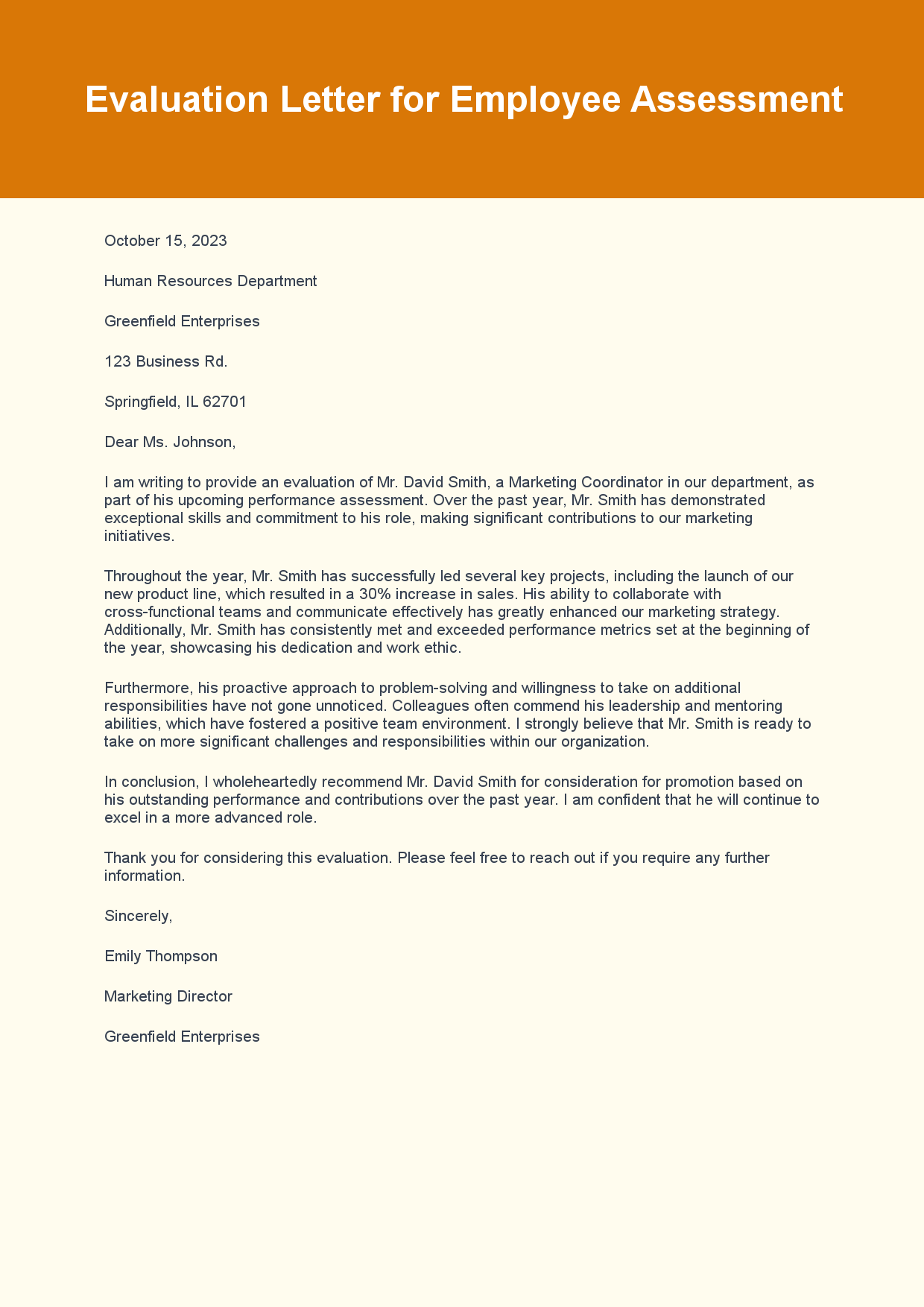
An Evaluation Letter for Employee Assessment is a formal document used by employers to review and communicate an employee's performance, strengths, and areas for improvement. This letter typically follows a structured assessment period and provides a comprehensive overview of the employee's contributions, skills, and adherence to company values. It serves not only as a record of performance but also as a tool for professional development, outlining specific goals and expectations for future growth.
Such letters are essential in fostering transparent communication between management and employees, allowing for constructive feedback and encouraging a culture of continuous improvement. By detailing achievements and challenges, the Evaluation Letter helps employees understand their standing within the organization and motivates them to enhance their performance.
Purpose & Importance of Evaluation Letter for Employee Assessment
An Evaluation Letter for Employee Assessment serves to formally review and provide feedback on an employee's performance, guiding their professional development and aligning their goals with organizational objectives.
- Performance Review: Summarizes key achievements and areas for improvement over the assessment period.
- Goal Setting: Outlines specific objectives for the next evaluation cycle to foster growth and accountability.
- Feedback Mechanism: Provides constructive criticism and positive reinforcement to encourage employee engagement.
- Recognition: Acknowledges outstanding contributions and encourages continued excellence within the team.
- Development Opportunities: Identifies training or mentorship programs to enhance skills and career progression.
When Should You Write a Evaluation Letter for Employee Assessment ?
- Annual Performance Review - This situation arises when a manager assesses an employee’s overall performance over the past year, providing feedback on achievements and areas for improvement.
- Promotion Consideration - An evaluation letter is necessary when recommending an employee for a promotion, highlighting their contributions and readiness for increased responsibilities.
- Probationary Period Assessment - After an employee completes their initial probationary period, an evaluation letter can summarize their performance and determine whether they will remain with the company.
- Project Completion Review - Following the completion of a significant project, a letter can assess the employee's role, contributions, and the impact of their work on the project's success.
- Performance Improvement Plan (PIP) Review - When an employee is on a PIP, an evaluation letter can outline progress made, setbacks encountered, and the next steps in their development.
- 360-Degree Feedback Summary - After collecting feedback from peers, subordinates, and supervisors, an evaluation letter can summarize the insights and provide a comprehensive view of the employee’s performance.
- Skill Development Assessment - When an employee has undergone training or skill development programs, an evaluation letter can assess how effectively they have applied new skills in their work.
- End of Contract Evaluation - For employees on fixed-term contracts, an evaluation letter can be issued at the end of their term to assess their contributions and consider future opportunities.
Format of a Evaluation Letter for Employee Assessment
When writing an Evaluation Letter for Employee Assessment, it’s essential to follow a structured approach to ensure clarity and professionalism. Below is a recommended structure that you can use to create an effective evaluation letter.
- Header
Include your company’s name, address, and contact information at the top. Follow this with the date and the employee’s name and address.
- Subject Line
Clearly state the purpose of the letter. For example, “Employee Performance Evaluation for [Employee Name].” This helps the recipient understand the letter's focus immediately.
- Salutation
Address the employee directly, using a formal greeting such as “Dear [Employee Name].” This sets a respectful tone for the letter.
- Introduction
Begin with a brief introduction that states the purpose of the evaluation letter. Mention the evaluation period and the overall context of the assessment.
- Performance Overview
Provide a summary of the employee's performance during the evaluation period. Highlight key accomplishments, strengths, and contributions to the team or organization.
- Areas for Improvement
Identify specific areas where the employee can improve. Offer constructive feedback and suggest ways to enhance their performance.
- Goals and Expectations
Set clear goals and expectations for the upcoming evaluation period. This helps the employee understand what is required for future success.
- Conclusion
Conclude the letter by summarizing the key points discussed. Express your confidence in the employee’s ability to succeed and offer your support.
- Closing
End with a formal closing such as “Sincerely” or “Best Regards,” followed by your name, title, and any necessary signatures. This adds a professional touch to the letter.
Sample Evaluation Letter for Employee Assessment
Explore five complete scenarios with fully written letters you can adapt immediately.
Evaluation Letter for Employee Assessment - Sample 1
Assessing an employee's performance for a potential promotion.
October 15, 2023
Human Resources Department
Greenfield Enterprises
123 Business Rd.
Springfield, IL 62701
Dear Ms. Johnson,
I am writing to provide an evaluation of Mr. David Smith, a Marketing Coordinator in our department, as part of his upcoming performance assessment. Over the past year, Mr. Smith has demonstrated exceptional skills and commitment to his role, making significant contributions to our marketing initiatives.
Throughout the year, Mr. Smith has successfully led several key projects, including the launch of our new product line, which resulted in a 30% increase in sales. His ability to collaborate with cross-functional teams and communicate effectively has greatly enhanced our marketing strategy. Additionally, Mr. Smith has consistently met and exceeded performance metrics set at the beginning of the year, showcasing his dedication and work ethic.
Furthermore, his proactive approach to problem-solving and willingness to take on additional responsibilities have not gone unnoticed. Colleagues often commend his leadership and mentoring abilities, which have fostered a positive team environment. I strongly believe that Mr. Smith is ready to take on more significant challenges and responsibilities within our organization.
In conclusion, I wholeheartedly recommend Mr. David Smith for consideration for promotion based on his outstanding performance and contributions over the past year. I am confident that he will continue to excel in a more advanced role.
Thank you for considering this evaluation. Please feel free to reach out if you require any further information.
Sincerely,
Emily Thompson
Marketing Director
Greenfield Enterprises
Human Resources Department
Greenfield Enterprises
123 Business Rd.
Springfield, IL 62701
Dear Ms. Johnson,
I am writing to provide an evaluation of Mr. David Smith, a Marketing Coordinator in our department, as part of his upcoming performance assessment. Over the past year, Mr. Smith has demonstrated exceptional skills and commitment to his role, making significant contributions to our marketing initiatives.
Throughout the year, Mr. Smith has successfully led several key projects, including the launch of our new product line, which resulted in a 30% increase in sales. His ability to collaborate with cross-functional teams and communicate effectively has greatly enhanced our marketing strategy. Additionally, Mr. Smith has consistently met and exceeded performance metrics set at the beginning of the year, showcasing his dedication and work ethic.
Furthermore, his proactive approach to problem-solving and willingness to take on additional responsibilities have not gone unnoticed. Colleagues often commend his leadership and mentoring abilities, which have fostered a positive team environment. I strongly believe that Mr. Smith is ready to take on more significant challenges and responsibilities within our organization.
In conclusion, I wholeheartedly recommend Mr. David Smith for consideration for promotion based on his outstanding performance and contributions over the past year. I am confident that he will continue to excel in a more advanced role.
Thank you for considering this evaluation. Please feel free to reach out if you require any further information.
Sincerely,
Emily Thompson
Marketing Director
Greenfield Enterprises
Download this letter in:
Evaluation Letter for Employee Assessment - Sample 2
This evaluation highlights Sarah's multi-departmental collaboration and leadership growth.
October 5, 2023
Human Resources Department
Innovative Solutions Corp.
123 Business Rd.
Springfield, IL 62701
Ms. Sarah Thompson
Project Manager
Innovative Solutions Corp.
456 Corporate Ave.
Springfield, IL 62701
Dear Ms. Thompson,
I am writing to formally evaluate your performance over the past six months in your role as Project Manager at Innovative Solutions Corp. Your dedication to fostering collaboration between our marketing and product development teams has resulted in significant improvements in project delivery times and overall team morale.
Your ability to lead cross-departmental meetings and facilitate open communication has not only enhanced productivity but has also encouraged a culture of teamwork within the organization. The feedback from both your peers and supervisors has been overwhelmingly positive, particularly regarding your initiative in addressing challenges and proposing effective solutions.
Moreover, your leadership during the recent product launch demonstrated your capacity to manage high-pressure situations while maintaining a focus on team objectives. The success of this launch has set a new standard for future projects and has showcased your potential for growth within our company.
As we move forward, I encourage you to continue developing your leadership skills and exploring opportunities for professional development. Your contributions are highly valued, and I look forward to seeing your continued success at Innovative Solutions Corp.
Thank you for your hard work and dedication.
Sincerely,
James R. Whitaker
Director of Human Resources
Innovative Solutions Corp.
Human Resources Department
Innovative Solutions Corp.
123 Business Rd.
Springfield, IL 62701
Ms. Sarah Thompson
Project Manager
Innovative Solutions Corp.
456 Corporate Ave.
Springfield, IL 62701
Dear Ms. Thompson,
I am writing to formally evaluate your performance over the past six months in your role as Project Manager at Innovative Solutions Corp. Your dedication to fostering collaboration between our marketing and product development teams has resulted in significant improvements in project delivery times and overall team morale.
Your ability to lead cross-departmental meetings and facilitate open communication has not only enhanced productivity but has also encouraged a culture of teamwork within the organization. The feedback from both your peers and supervisors has been overwhelmingly positive, particularly regarding your initiative in addressing challenges and proposing effective solutions.
Moreover, your leadership during the recent product launch demonstrated your capacity to manage high-pressure situations while maintaining a focus on team objectives. The success of this launch has set a new standard for future projects and has showcased your potential for growth within our company.
As we move forward, I encourage you to continue developing your leadership skills and exploring opportunities for professional development. Your contributions are highly valued, and I look forward to seeing your continued success at Innovative Solutions Corp.
Thank you for your hard work and dedication.
Sincerely,
James R. Whitaker
Director of Human Resources
Innovative Solutions Corp.
Download this letter in:
Evaluation Letter for Employee Assessment - Sample 3
John Smith has excelled in his role, exceeding performance objectives.
October 15, 2023
Human Resources Department
Tech Innovations Inc.
1234 Technology Way
Silicon Valley, CA 94043
Dear Ms. Johnson,
I hope this letter finds you well. I am writing to formally evaluate the performance of John Smith, who has been with Tech Innovations Inc. for the past year as a Software Developer. In this time, John has consistently exceeded expectations and demonstrated exceptional skills that contribute significantly to our team.
Throughout the year, John has successfully led multiple projects, including the recent launch of our new application, which has received positive feedback from clients and stakeholders alike. His ability to collaborate effectively with team members and communicate complex ideas clearly has been instrumental in meeting our deadlines and achieving our goals.
Moreover, John has shown a proactive approach to problem-solving, often identifying potential issues before they escalate. His willingness to take on additional responsibilities and mentor new team members highlights his commitment to both personal and team growth. I believe that John possesses the qualities that align with our company’s mission and values.
In conclusion, I strongly recommend John Smith for any upcoming opportunities for advancement within our organization. His contributions have not only benefited our projects but have also fostered a positive work environment.
Thank you for considering this evaluation in your assessment process. Should you need any further details, please feel free to reach out.
Sincerely,
Emily Carter
Senior Project Manager
Tech Innovations Inc.
Human Resources Department
Tech Innovations Inc.
1234 Technology Way
Silicon Valley, CA 94043
Dear Ms. Johnson,
I hope this letter finds you well. I am writing to formally evaluate the performance of John Smith, who has been with Tech Innovations Inc. for the past year as a Software Developer. In this time, John has consistently exceeded expectations and demonstrated exceptional skills that contribute significantly to our team.
Throughout the year, John has successfully led multiple projects, including the recent launch of our new application, which has received positive feedback from clients and stakeholders alike. His ability to collaborate effectively with team members and communicate complex ideas clearly has been instrumental in meeting our deadlines and achieving our goals.
Moreover, John has shown a proactive approach to problem-solving, often identifying potential issues before they escalate. His willingness to take on additional responsibilities and mentor new team members highlights his commitment to both personal and team growth. I believe that John possesses the qualities that align with our company’s mission and values.
In conclusion, I strongly recommend John Smith for any upcoming opportunities for advancement within our organization. His contributions have not only benefited our projects but have also fostered a positive work environment.
Thank you for considering this evaluation in your assessment process. Should you need any further details, please feel free to reach out.
Sincerely,
Emily Carter
Senior Project Manager
Tech Innovations Inc.
Download this letter in:
Evaluation Letter for Employee Assessment - Sample 4
Annual performance evaluation for a recently promoted project manager.
March 15, 2023
Human Resources Department
Tech Innovations Inc.
123 Innovation Way
Suite 400
San Francisco, CA 94105
Dear John Smith,
I hope this letter finds you well. As part of our annual employee assessment process, I am writing to provide you with an evaluation of your performance over the past year since your promotion to Project Manager.
Throughout this assessment period, you have demonstrated exceptional leadership qualities and a strong commitment to your team's success. Your ability to manage complex projects while fostering a collaborative environment has significantly contributed to the overall productivity of your department. Specifically, your leadership during the XYZ project resulted in a 15% reduction in costs while meeting all deadlines.
Moreover, your communication skills have enhanced team dynamics, allowing for open discussions and innovative ideas to flourish. I appreciate your initiative in organizing regular team-building activities, which have further strengthened relationships among team members.
While your performance has been commendable, I encourage you to continue developing your strategic planning skills to better align your team’s objectives with the company's long-term goals. I believe that with focused training and mentorship, you can further excel in your role.
Thank you for your hard work and dedication to Tech Innovations Inc. We look forward to your continued success and contributions in the upcoming year.
Sincerely,
Emily Johnson
Director of Human Resources
Tech Innovations Inc.
Human Resources Department
Tech Innovations Inc.
123 Innovation Way
Suite 400
San Francisco, CA 94105
Dear John Smith,
I hope this letter finds you well. As part of our annual employee assessment process, I am writing to provide you with an evaluation of your performance over the past year since your promotion to Project Manager.
Throughout this assessment period, you have demonstrated exceptional leadership qualities and a strong commitment to your team's success. Your ability to manage complex projects while fostering a collaborative environment has significantly contributed to the overall productivity of your department. Specifically, your leadership during the XYZ project resulted in a 15% reduction in costs while meeting all deadlines.
Moreover, your communication skills have enhanced team dynamics, allowing for open discussions and innovative ideas to flourish. I appreciate your initiative in organizing regular team-building activities, which have further strengthened relationships among team members.
While your performance has been commendable, I encourage you to continue developing your strategic planning skills to better align your team’s objectives with the company's long-term goals. I believe that with focused training and mentorship, you can further excel in your role.
Thank you for your hard work and dedication to Tech Innovations Inc. We look forward to your continued success and contributions in the upcoming year.
Sincerely,
Emily Johnson
Director of Human Resources
Tech Innovations Inc.
Download this letter in:
Evaluation Letter for Employee Assessment - Sample 5
John Smith has consistently exceeded performance expectations in his role as a Project Manager.
April 15, 2023
Human Resources Department
Innovative Solutions Inc.
123 Business Rd.
Cityville, ST 12345
Mr. John Smith
Project Manager
Innovative Solutions Inc.
123 Business Rd.
Cityville, ST 12345
Dear Mr. Smith,
I am writing to formally evaluate your performance as a Project Manager for the period of January 2022 to March 2023. After a thorough review of your contributions, I am pleased to report that you have consistently exceeded our expectations in your role.
Your leadership on the recent XYZ project was exemplary, showcasing not only your ability to manage resources effectively but also your skill in fostering collaboration among team members. The project was completed ahead of schedule and under budget, which has had a significant positive impact on our company’s bottom line. Your proactive approach to problem-solving and your strategic thinking have set a benchmark for your peers.
Additionally, your commitment to professional development is commendable. Your participation in the leadership training program and your initiative in mentoring junior staff demonstrate your dedication to both personal growth and the growth of those around you.
Overall, your performance has not only contributed to the success of your team but has also aligned perfectly with the company’s values and goals. We look forward to seeing your continued growth and contributions in the coming year.
Thank you for your hard work and dedication to Innovative Solutions Inc.
Sincerely,
Sarah Johnson
Director of Human Resources
Innovative Solutions Inc.
Human Resources Department
Innovative Solutions Inc.
123 Business Rd.
Cityville, ST 12345
Mr. John Smith
Project Manager
Innovative Solutions Inc.
123 Business Rd.
Cityville, ST 12345
Dear Mr. Smith,
I am writing to formally evaluate your performance as a Project Manager for the period of January 2022 to March 2023. After a thorough review of your contributions, I am pleased to report that you have consistently exceeded our expectations in your role.
Your leadership on the recent XYZ project was exemplary, showcasing not only your ability to manage resources effectively but also your skill in fostering collaboration among team members. The project was completed ahead of schedule and under budget, which has had a significant positive impact on our company’s bottom line. Your proactive approach to problem-solving and your strategic thinking have set a benchmark for your peers.
Additionally, your commitment to professional development is commendable. Your participation in the leadership training program and your initiative in mentoring junior staff demonstrate your dedication to both personal growth and the growth of those around you.
Overall, your performance has not only contributed to the success of your team but has also aligned perfectly with the company’s values and goals. We look forward to seeing your continued growth and contributions in the coming year.
Thank you for your hard work and dedication to Innovative Solutions Inc.
Sincerely,
Sarah Johnson
Director of Human Resources
Innovative Solutions Inc.
Download this letter in:
Tips to Write an Effective Evaluation Letter for Employee Assessment
- Be Clear: Use straightforward language to communicate your assessment clearly.
- Focus on Specifics: Provide concrete examples to support your evaluation.
- Balance Feedback: Include both strengths and areas for improvement to give a well-rounded view.
- Set Goals: Outline clear, achievable objectives for the employee's future development.
- Use Professional Tone: Maintain a respectful and professional tone throughout the letter.
- Be Constructive: Frame criticisms as opportunities for growth, not just negatives.
- Encourage Dialogue: Invite the employee to discuss their evaluation and share their perspective.
- Keep it Concise: Stick to relevant information to maintain the reader’s attention.
- Highlight Achievements: Acknowledge significant contributions to motivate continued performance.
- Tailor Content: Customize the letter to fit the individual’s role and performance context.
- Use Action Verbs: Start sentences with strong action verbs to convey dynamism in your evaluation.
- Include Metrics: Use measurable outcomes where applicable to quantify performance.
- Proofread: Ensure there are no grammatical or spelling errors to maintain professionalism.
- Follow Company Guidelines: Adhere to any specific templates or protocols established by your organization.
- End on a Positive Note: Conclude with encouragement and support for the employee’s future success.
Common Mistakes to Avoid in Evaluation Letter for Employee Assessment
- Lack of Specificity - Failing to provide specific examples of performance can make the letter vague and unhelpful. It is essential to cite particular instances that illustrate the employee's strengths and areas for improvement.
- Overly Positive or Negative Tone - Striking a balance is crucial; an overly positive letter may come off as insincere, while an excessively negative tone can demotivate the employee. Aim for a constructive and balanced perspective.
- Ignoring Job Description - Not aligning the evaluation with the employee's job description can lead to a lack of relevance. Ensure that the assessment reflects the responsibilities and expectations outlined in their role.
- Failure to Include Development Goals - Neglecting to set goals for future performance can limit the employee's growth. Including development objectives helps guide the employee in their professional journey.
- Inconsistent Feedback - Providing feedback that contradicts previous evaluations can cause confusion and undermine credibility. Consistency in assessments over time is key to building trust.
- Neglecting Employee Input - Not incorporating the employee's self-assessment or feedback can make them feel undervalued. Encouraging input fosters a two-way dialogue and shows that their perspective is appreciated.
- Using Jargon or Complex Language - Overly technical or convoluted language can alienate the employee. Aim for clear and straightforward language that is easily understood.
- Skipping a Summary - Failing to summarize key points at the end can leave the reader without a clear understanding of the overall assessment. A concise conclusion reinforces the main takeaways.
Subject Line Examples for Evaluation Letter for Employee Assessment
- Your performance evaluation letter is ready for review
- Important: Your employee assessment letter has been issued
- Discover the insights from your recent evaluation
- Review your official evaluation letter today
- Unlock your potential: Access your assessment letter now
- Evaluation letter: Key takeaways from your performance review
- Your performance assessment letter is now available
- What your evaluation letter means for your career growth
- Time to reflect: Your evaluation letter awaits
- Find out how you’ve been assessed in your latest evaluation
- Action required: Review your employee evaluation letter
- Your evaluation results are in: Read your letter now
- Insights from your evaluation letter: What’s next for you?
- Get the details: Your employee assessment letter is here
- Understanding your evaluation letter: Key points explained
- Take the next step: Review your performance evaluation letter
Useful Phrases & Lines for Evaluation Letter for Employee Assessment
Opening Lines
- Dear [Employee's Name],
- We appreciate your hard work and dedication over the past evaluation period.
- This letter serves as a formal assessment of your performance in your role as [Job Title].
- We aim to provide constructive feedback to support your professional growth.
Body Lines
- Your contributions to [specific project or task] have been invaluable, demonstrating your ability to [specific skill or quality].
- We have observed a significant improvement in your [specific area, e.g., communication, teamwork, etc.].
- However, there are opportunities for development in [specific area for improvement], and we encourage you to focus on this moving forward.
- Your adherence to deadlines and quality of work has been commendable, reflecting your commitment to excellence.
- Overall, your performance has met [or exceeded] expectations, and we are excited to see your continued growth.
Closing Lines
- We value your contributions to the team and look forward to your ongoing development.
- Please feel free to reach out if you have any questions or if you would like to discuss this evaluation further.
- Thank you for your hard work and dedication to [Company Name].
- Best regards,
- [Your Name] [Your Job Title] [Company Name]
FAQs about Evaluation Letter for Employee Assessment
- What is an evaluation letter for employee assessment?
An evaluation letter for employee assessment is a formal document that summarizes an employee's performance, skills, and contributions over a specific period. It is often used for performance reviews, promotions, or professional development purposes.
- Who typically writes an evaluation letter?
Evaluation letters are usually written by supervisors, managers, or team leaders who are familiar with the employee's work. In some cases, peer evaluations may also contribute to the overall assessment.
- What key components should be included in an evaluation letter?
Key components of an evaluation letter include employee information, assessment period, performance categories (e.g., strengths, areas for improvement), specific examples of achievements, and any recommendations for future development or training.
- How is an evaluation letter used in the employee review process?
Evaluation letters play a crucial role in the employee review process by providing a structured overview of performance. They serve as a basis for discussions during review meetings and can influence decisions regarding promotions, raises, or disciplinary actions.
- Can evaluation letters be used for employee development plans?
Yes, evaluation letters can be instrumental in creating employee development plans. By identifying areas for improvement and setting specific goals, these letters help employees understand their growth opportunities and align their professional development with organizational objectives.
- Are evaluation letters confidential?
Evaluation letters are generally considered confidential documents. Access is typically restricted to the employee, their supervisor, and HR personnel to ensure privacy and encourage honest feedback during the assessment process.
Incorporating the guidance provided in the Evaluation Letter for Employee Assessment will not only enhance the clarity and impact of your communication but also foster a culture of constructive feedback within your organization. By following these best practices, you empower both yourself and your employees to engage in meaningful discussions about performance and development. Take this opportunity to refine your evaluation letters, and watch as they become powerful tools for motivation and growth. Embrace this approach, and set the stage for success in your workplace.