The Formal Letter for Information Inquiry serves as an essential tool for individuals and organizations seeking specific details or clarification on various subjects. This structured format not only conveys professionalism but also ensures that the request is clear and concise, facilitating effective communication between the sender and the recipient.
Formal Letter for Information Inquiry
Looking for more examples like this? Explore the Formal Letters for additional letter templates and guidance.
What Is a Formal Letter for Information Inquiry?
A Formal Letter for Information Inquiry is a structured communication designed to request specific information from an individual or organization. This type of letter typically follows a professional format, including the sender's address, date, recipient's address, a formal salutation, and a clear subject line. The body of the letter outlines the information being sought, articulating the purpose of the inquiry and any relevant context that may help the recipient respond effectively.
Such letters are commonly used in various contexts, including business, education, and government, to ensure clarity and professionalism in communication. A well-crafted inquiry letter not only facilitates the exchange of information but also establishes a respectful tone, fostering positive relationships between the parties involved.
Purpose & Importance of Formal Letter for Information Inquiry
A Formal Letter for Information Inquiry serves to request specific details or clarification from an organization or individual, ensuring clear communication and professionalism.
- Clear Subject Line: Begin with a concise subject line that reflects the purpose of your inquiry.
- Polite Greeting: Address the recipient formally, using their title and last name to set a respectful tone.
- Specific Information Request: Clearly outline the information you seek, providing context to facilitate a comprehensive response.
- Deadline Mention: If applicable, indicate a timeframe by which you would appreciate a response to assist in your planning.
- Professional Closing: End with a courteous closing statement, expressing gratitude for their assistance and including your contact information.
When Should You Write a Formal Letter for Information Inquiry ?
- Job Application Inquiry - When a candidate wants to inquire about the status of their job application or seek clarification about a specific position, a formal letter can provide a professional way to communicate with the hiring manager or HR department.
- Product Information Request - Businesses or individuals may need to write a formal letter to request detailed information about a product's specifications, pricing, or availability from a supplier or manufacturer.
- Service Clarification Request - When a customer requires clarification about the services offered by a company, such as terms, pricing, or features, a formal inquiry letter can be an effective means of communication.
- Academic Program Inquiry - Prospective students may write a formal letter to inquire about the details of an academic program, including admission requirements, course offerings, and enrollment deadlines.
- Partnership Proposal Inquiry - Businesses looking to explore potential partnerships or collaborations may need to formally inquire about the possibility of working together and request additional information about the other party’s interests.
- Event Participation Inquiry - Individuals or organizations interested in participating in conferences, seminars, or workshops may write formal letters to inquire about registration details, agenda, and participation requirements.
- Regulatory Compliance Information - Companies may need to write to regulatory bodies to seek information regarding compliance requirements or changes in regulations that may impact their operations.
- Membership Information Request - Individuals seeking to join professional organizations may write a formal letter to request information about membership benefits, fees, and application procedures.
- Grant or Funding Inquiry - Non-profits or researchers looking for financial support may write formal letters to funding organizations to inquire about available grants, eligibility criteria, and application processes.
Format of a Formal Letter for Information Inquiry
A Formal Letter for Information Inquiry is a structured document used to request specific information from an organization or individual. Below is a recommended structure to ensure that your inquiry is clear, concise, and professional.
-
Sender’s Address
Begin with your address at the top right corner of the letter. Include your full name, street address, city, state, and zip code. This information should be current and accurate to allow for a response.
-
Date
After your address, include the date on which you are writing the letter. This should be aligned with the left margin and can be formatted as "Month Day, Year."
-
Recipient’s Address
Below the date, add the recipient's address. Include the recipient's name (if known), their title, organization name, street address, city, state, and zip code. Ensure that the information is correct to prevent any delays in receiving a reply.
-
Salutation
Use a formal greeting, such as "Dear [Recipient's Name]," or "To Whom It May Concern," if the specific name is unknown. Always follow the salutation with a comma.
-
Introduction
Start the body of your letter with a brief introduction that states who you are and the purpose of your inquiry. Be direct and concise to engage the reader's attention quickly.
-
Details of the Inquiry
Elaborate on the specific information you are seeking. Provide context where necessary and clearly outline any questions you have. This section should be well-organized and easy to follow.
-
Closing Remarks
Express appreciation for their time and assistance. You may also indicate your willingness to provide further information if needed and mention how you can be reached.
-
Complimentary Close
End with a formal closing such as "Sincerely," or "Best regards," followed by a comma. Leave space for your signature (if sending a hard copy) before typing your name.
-
Enclosures (if applicable)
If you are including additional documents, note this under your name by stating "Enclosures:" followed by a list of the documents attached.
Sample Formal Letter for Information Inquiry
Explore five complete scenarios with fully written letters you can adapt immediately.
Formal Letter for Information Inquiry - Sample 1
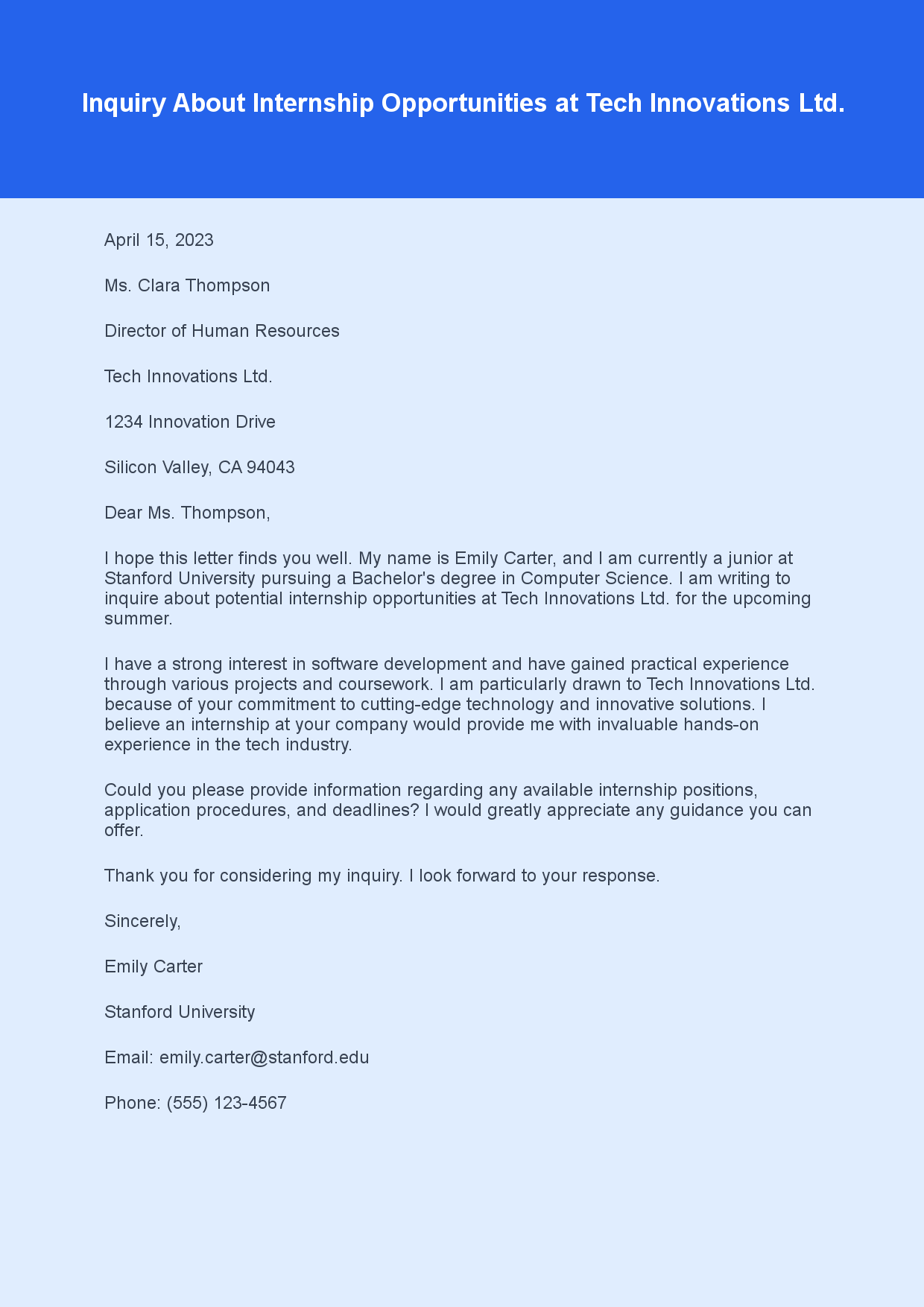
A university student is inquiring about potential internship opportunities at a tech company.
April 15, 2023
Ms. Clara Thompson
Director of Human Resources
Tech Innovations Ltd.
1234 Innovation Drive
Silicon Valley, CA 94043
Dear Ms. Thompson,
I hope this letter finds you well. My name is Emily Carter, and I am currently a junior at Stanford University pursuing a Bachelor's degree in Computer Science. I am writing to inquire about potential internship opportunities at Tech Innovations Ltd. for the upcoming summer.
I have a strong interest in software development and have gained practical experience through various projects and coursework. I am particularly drawn to Tech Innovations Ltd. because of your commitment to cutting-edge technology and innovative solutions. I believe an internship at your company would provide me with invaluable hands-on experience in the tech industry.
Could you please provide information regarding any available internship positions, application procedures, and deadlines? I would greatly appreciate any guidance you can offer.
Thank you for considering my inquiry. I look forward to your response.
Sincerely,
Emily Carter
Stanford University
Email: [email protected]
Phone: (555) 123-4567
Ms. Clara Thompson
Director of Human Resources
Tech Innovations Ltd.
1234 Innovation Drive
Silicon Valley, CA 94043
Dear Ms. Thompson,
I hope this letter finds you well. My name is Emily Carter, and I am currently a junior at Stanford University pursuing a Bachelor's degree in Computer Science. I am writing to inquire about potential internship opportunities at Tech Innovations Ltd. for the upcoming summer.
I have a strong interest in software development and have gained practical experience through various projects and coursework. I am particularly drawn to Tech Innovations Ltd. because of your commitment to cutting-edge technology and innovative solutions. I believe an internship at your company would provide me with invaluable hands-on experience in the tech industry.
Could you please provide information regarding any available internship positions, application procedures, and deadlines? I would greatly appreciate any guidance you can offer.
Thank you for considering my inquiry. I look forward to your response.
Sincerely,
Emily Carter
Stanford University
Email: [email protected]
Phone: (555) 123-4567
Download this letter in:
Formal Letter for Information Inquiry - Sample 2
A university professor seeks collaboration with a tech company on a research project.
March 15, 2023
Dr. Emily Carter
Department of Computer Science
Greenfield University
123 Academic Way
Greenfield, CA 90210
Mr. Thomas Reynolds
Director of Research and Development
Innovative Tech Solutions
456 Industry Blvd
Tech City, CA 90220
Dear Mr. Reynolds,
I hope this message finds you well. My name is Dr. Emily Carter, and I am a professor in the Department of Computer Science at Greenfield University. I am reaching out to inquire about potential collaboration opportunities between Innovative Tech Solutions and our department regarding ongoing research in artificial intelligence and machine learning.
At Greenfield University, we are currently undertaking several projects that align with the innovative work being done at your company. We believe that a partnership could be mutually beneficial, allowing us to leverage your expertise and resources while also providing valuable insights from our academic research.
I would appreciate the opportunity to discuss this further and explore how we might work together. Please let me know if you would be available for a meeting in the coming weeks, either in person or via video conference. Thank you for considering this inquiry, and I look forward to your response.
Sincerely,
Dr. Emily Carter
Professor, Department of Computer Science
Greenfield University
email: [email protected]
phone: (555) 123-4567
Dr. Emily Carter
Department of Computer Science
Greenfield University
123 Academic Way
Greenfield, CA 90210
Mr. Thomas Reynolds
Director of Research and Development
Innovative Tech Solutions
456 Industry Blvd
Tech City, CA 90220
Dear Mr. Reynolds,
I hope this message finds you well. My name is Dr. Emily Carter, and I am a professor in the Department of Computer Science at Greenfield University. I am reaching out to inquire about potential collaboration opportunities between Innovative Tech Solutions and our department regarding ongoing research in artificial intelligence and machine learning.
At Greenfield University, we are currently undertaking several projects that align with the innovative work being done at your company. We believe that a partnership could be mutually beneficial, allowing us to leverage your expertise and resources while also providing valuable insights from our academic research.
I would appreciate the opportunity to discuss this further and explore how we might work together. Please let me know if you would be available for a meeting in the coming weeks, either in person or via video conference. Thank you for considering this inquiry, and I look forward to your response.
Sincerely,
Dr. Emily Carter
Professor, Department of Computer Science
Greenfield University
email: [email protected]
phone: (555) 123-4567
Download this letter in:
Formal Letter for Information Inquiry - Sample 3
Requesting information on potential research collaboration in renewable energy.
November 15, 2023
Dr. Emily Carter
Director of Research Initiatives
Green Future Institute
123 Sustainability Way
Eco City, CA 90210
Dear Dr. Carter,
I hope this letter finds you well. My name is Johnathan Lee, and I am a Senior Researcher at the Institute of Renewable Energy at Green Valley University. We are currently exploring new avenues for collaboration in the field of renewable energy technologies and are keen to learn more about the initiatives at the Green Future Institute.
We believe that a partnership between our institutions could lead to innovative solutions that address pressing environmental challenges. Specifically, we are interested in your recent projects related to solar energy and energy storage systems. We would appreciate any information you could provide regarding ongoing research efforts, available resources, and potential opportunities for joint projects.
Thank you for considering our inquiry. I look forward to your response and the possibility of collaborating to advance our shared goals in sustainable energy.
Sincerely,
Johnathan Lee
Senior Researcher
Institute of Renewable Energy
Green Valley University
456 Research Lane
Green Valley, CA 90123
Dr. Emily Carter
Director of Research Initiatives
Green Future Institute
123 Sustainability Way
Eco City, CA 90210
Dear Dr. Carter,
I hope this letter finds you well. My name is Johnathan Lee, and I am a Senior Researcher at the Institute of Renewable Energy at Green Valley University. We are currently exploring new avenues for collaboration in the field of renewable energy technologies and are keen to learn more about the initiatives at the Green Future Institute.
We believe that a partnership between our institutions could lead to innovative solutions that address pressing environmental challenges. Specifically, we are interested in your recent projects related to solar energy and energy storage systems. We would appreciate any information you could provide regarding ongoing research efforts, available resources, and potential opportunities for joint projects.
Thank you for considering our inquiry. I look forward to your response and the possibility of collaborating to advance our shared goals in sustainable energy.
Sincerely,
Johnathan Lee
Senior Researcher
Institute of Renewable Energy
Green Valley University
456 Research Lane
Green Valley, CA 90123
Download this letter in:
Formal Letter for Information Inquiry - Sample 4
A university student seeks information about potential internship openings for summer 2024.
April 5, 2024
Dr. Sarah Thompson
Director of Human Resources
Tech Innovations Inc.
123 Technology Lane
San Francisco, CA 94105
Dear Dr. Thompson,
I hope this message finds you well. My name is Emily Carter, and I am currently a junior majoring in Computer Science at Stanford University. I am writing to inquire about potential internship opportunities at Tech Innovations Inc. for the upcoming summer of 2024.
I have a strong interest in software development and a passion for innovative technology solutions. I am particularly impressed by Tech Innovations Inc.'s commitment to advancing artificial intelligence and its applications across various industries. I believe that an internship at your esteemed company would provide me with invaluable experience and allow me to contribute to your ongoing projects.
Could you please provide me with information regarding any available internship positions, application deadlines, and the application process? Additionally, I would appreciate any insights you can share about the skills and qualifications you seek in candidates.
Thank you for your time and assistance. I look forward to your response and hope to explore the possibility of contributing to Tech Innovations Inc. this summer.
Sincerely,
Emily Carter
Stanford University
Department of Computer Science
[email protected]
(555) 123-4567
Dr. Sarah Thompson
Director of Human Resources
Tech Innovations Inc.
123 Technology Lane
San Francisco, CA 94105
Dear Dr. Thompson,
I hope this message finds you well. My name is Emily Carter, and I am currently a junior majoring in Computer Science at Stanford University. I am writing to inquire about potential internship opportunities at Tech Innovations Inc. for the upcoming summer of 2024.
I have a strong interest in software development and a passion for innovative technology solutions. I am particularly impressed by Tech Innovations Inc.'s commitment to advancing artificial intelligence and its applications across various industries. I believe that an internship at your esteemed company would provide me with invaluable experience and allow me to contribute to your ongoing projects.
Could you please provide me with information regarding any available internship positions, application deadlines, and the application process? Additionally, I would appreciate any insights you can share about the skills and qualifications you seek in candidates.
Thank you for your time and assistance. I look forward to your response and hope to explore the possibility of contributing to Tech Innovations Inc. this summer.
Sincerely,
Emily Carter
Stanford University
Department of Computer Science
[email protected]
(555) 123-4567
Download this letter in:
Formal Letter for Information Inquiry - Sample 5
Requesting detailed information on admission criteria for a Master's program.
October 12, 2023
Dr. Emily Thompson
Director of Graduate Admissions
Greenwood University
123 Academic Way
Greenwood, IL 60000
Dear Dr. Thompson,
I hope this letter finds you well. My name is Michael Carter, and I am currently a senior at Rivers Edge College, where I am pursuing my Bachelor's degree in Environmental Science. I am writing to inquire about the admission requirements for the Master’s program in Environmental Policy at Greenwood University.
I am particularly interested in understanding the prerequisites for applicants, including any necessary standardized test scores, letters of recommendation, and specific coursework. Additionally, I would appreciate any information regarding application deadlines and whether there are opportunities for financial aid or assistantships for graduate students.
Thank you for your assistance. I look forward to your response and hope to learn more about the program and how I can prepare my application effectively.
Sincerely,
Michael Carter
123 River Lane
Springfield, IL 62701
(555) 987-6543
[email protected]
Dr. Emily Thompson
Director of Graduate Admissions
Greenwood University
123 Academic Way
Greenwood, IL 60000
Dear Dr. Thompson,
I hope this letter finds you well. My name is Michael Carter, and I am currently a senior at Rivers Edge College, where I am pursuing my Bachelor's degree in Environmental Science. I am writing to inquire about the admission requirements for the Master’s program in Environmental Policy at Greenwood University.
I am particularly interested in understanding the prerequisites for applicants, including any necessary standardized test scores, letters of recommendation, and specific coursework. Additionally, I would appreciate any information regarding application deadlines and whether there are opportunities for financial aid or assistantships for graduate students.
Thank you for your assistance. I look forward to your response and hope to learn more about the program and how I can prepare my application effectively.
Sincerely,
Michael Carter
123 River Lane
Springfield, IL 62701
(555) 987-6543
[email protected]
Download this letter in:
Tips to Write an Effective Formal Letter for Information Inquiry
- Identify the Recipient: Clearly state who you are addressing to ensure your letter reaches the right person.
- Use a Professional Format: Stick to standard letter formatting including your address, date, and recipient's address.
- Start with a Polite Greeting: Use a formal salutation such as "Dear [Title] [Last Name]."
- State Your Purpose: Begin with a clear **statement of intent** to inform the reader why you are writing.
- Be Concise: Keep your letter short and to the point; avoid unnecessary jargon or lengthy explanations.
- Ask Specific Questions: Formulate clear, direct questions to guide the recipient in providing the information you need.
- Provide Context: Briefly outline any relevant background information that will help the recipient understand your request.
- Maintain a Professional Tone: Use polite and formal language throughout your letter to convey respect.
- Include a Call to Action: Clearly state what you would like the recipient to do next, such as providing information or setting up a meeting.
- Offer Your Contact Details: Provide your email and phone number to facilitate easy communication.
- Proofread Your Letter: Check for spelling and grammatical errors to ensure professionalism.
- Use a Formal Closing: Conclude with a respectful sign-off, like "Sincerely" or "Yours faithfully."
- Attach Relevant Documents: If necessary, include any supporting documents that may help your inquiry.
- Keep a Copy: Retain a copy of the letter for your records and future reference.
- Follow Up: If you don’t receive a response in a reasonable time, consider sending a polite follow-up email or letter.
Common Mistakes to Avoid in Formal Letter for Information Inquiry
- Neglecting a Clear Purpose - Failing to clearly state the purpose of the inquiry at the beginning can lead to confusion and hinder the recipient's ability to provide the needed information.
- Inappropriate Tone - Using an overly casual or informal tone can undermine the professionalism of the letter; a formal inquiry should maintain a respectful and courteous tone throughout.
- Omitting Necessary Details - Not providing sufficient context or background information can result in the recipient not fully understanding the request, which may delay their response.
- Improper Formatting - Ignoring standard formatting conventions, such as proper salutations, paragraph spacing, and closing statements, can make the letter appear unprofessional.
- Incorrect Addressing - Failing to address the letter to the correct person or department may lead to miscommunication or the letter going unanswered.
- Overloading with Questions - Asking too many questions at once can overwhelm the recipient; it's better to focus on the most crucial inquiries to facilitate a clearer response.
- Not Proofreading - Neglecting to proofread for typos, grammatical errors, or awkward phrasing can diminish the letter's credibility and professionalism.
- Ignoring Follow-Up Procedures - Failing to mention a follow-up plan or timeline can leave the recipient unsure about how soon they should respond or if follow-up is expected.
Subject Line Examples for Formal Letter for Information Inquiry
- Request for information: Formal letter inquiry
- Your guidance needed: Information request
- Seeking clarity: Formal inquiry on [specific topic]
- Information needed: Formal request for details
- Inquiry letter: Request for essential information
- Assistance required: Formal information inquiry
- Request for details: Formal letter submission
- Clarification needed: Inquiry into [specific topic]
- Following up: Information request via formal letter
- Inquiring about [specific topic]: Your assistance appreciated
- Formal inquiry: Seeking your expertise on [specific topic]
- Information inquiry: Your insights would be valuable
- Request for information: We value your input
- Need your help: Formal inquiry for clarity
- Seeking information: Formal request from [your name/organization]
- Can you help? Formal request for information
Useful Phrases & Lines for Formal Letter for Information Inquiry
Opening Lines
- Dear [Recipient's Name],
- I hope this message finds you well.
- I am writing to request information regarding [specific subject].
- As a [your position or title] at [your organization], I am keen to learn more about [specific topic].
Body Lines
- Could you please provide details on [specific information needed]?
- I would appreciate any documents or resources that outline [relevant information].
- Understanding this information is crucial for [explain reason or purpose].
- If possible, I would be grateful for your response by [specific deadline].
Closing Lines
- Thank you for your attention to this matter.
- I look forward to your prompt response.
- Please feel free to reach me at [your contact information] should you require any further details.
- Best regards,
- [Your Name]
- [Your Position]
- [Your Organization]
FAQs about Formal Letter for Information Inquiry
- What is a Formal Letter for Information Inquiry?
A Formal Letter for Information Inquiry is a written request sent to an organization or individual seeking specific information. It is structured and polite, aiming to elicit a clear response regarding the subject matter of interest.
- How should I format a Formal Letter for Information Inquiry?
The letter should include your address, the date, the recipient's address, a formal greeting, the body of the letter detailing your inquiry, a closing statement, and your signature. Use a professional tone and clear, concise language throughout.
- What should be included in the body of the letter?
The body should introduce yourself, state the purpose of the inquiry, specify the information you need, and provide any context that may help the recipient understand your request. Be courteous and direct in your phrasing.
- Is it necessary to include a deadline for the response?
While not mandatory, including a reasonable deadline can be helpful. It sets expectations for when you would like to receive the information, but ensure it is polite and allows sufficient time for the recipient to respond.
- How can I ensure a prompt response to my inquiry?
To encourage a timely reply, be clear and specific in your request, keep the letter concise, and use a polite tone. Including your contact information and expressing appreciation for their assistance can also facilitate a quicker response.
- What should I do if I don't receive a response?
If you do not receive a response within a reasonable time frame, consider sending a follow-up letter or email. Politely reiterate your inquiry, express your continued interest, and ask if they need any further information from you.
In conclusion, embracing the guidance provided for your Formal Letter for Information Inquiry will not only enhance your communication skills but also ensure your requests are clear and professional. By applying these principles, you'll foster stronger relationships and facilitate more effective responses from your recipients. Take the initiative to implement these strategies in your correspondence, and watch as your inquiries yield the positive results you seek. Your commitment to polished and purposeful communication will undoubtedly set you apart in any professional setting.