A Grievance Letter for Workplace Issue is a formal document used to address concerns or disputes that arise in the workplace. This letter serves as a structured means for employees to communicate their grievances to management, ensuring that issues are acknowledged and resolved in a timely and appropriate manner.
Grievance Letter for Workplace Issue
Looking for more examples like this? Explore the Grievance Letters for additional letter templates and guidance.
What Is a Grievance Letter for Workplace Issue?
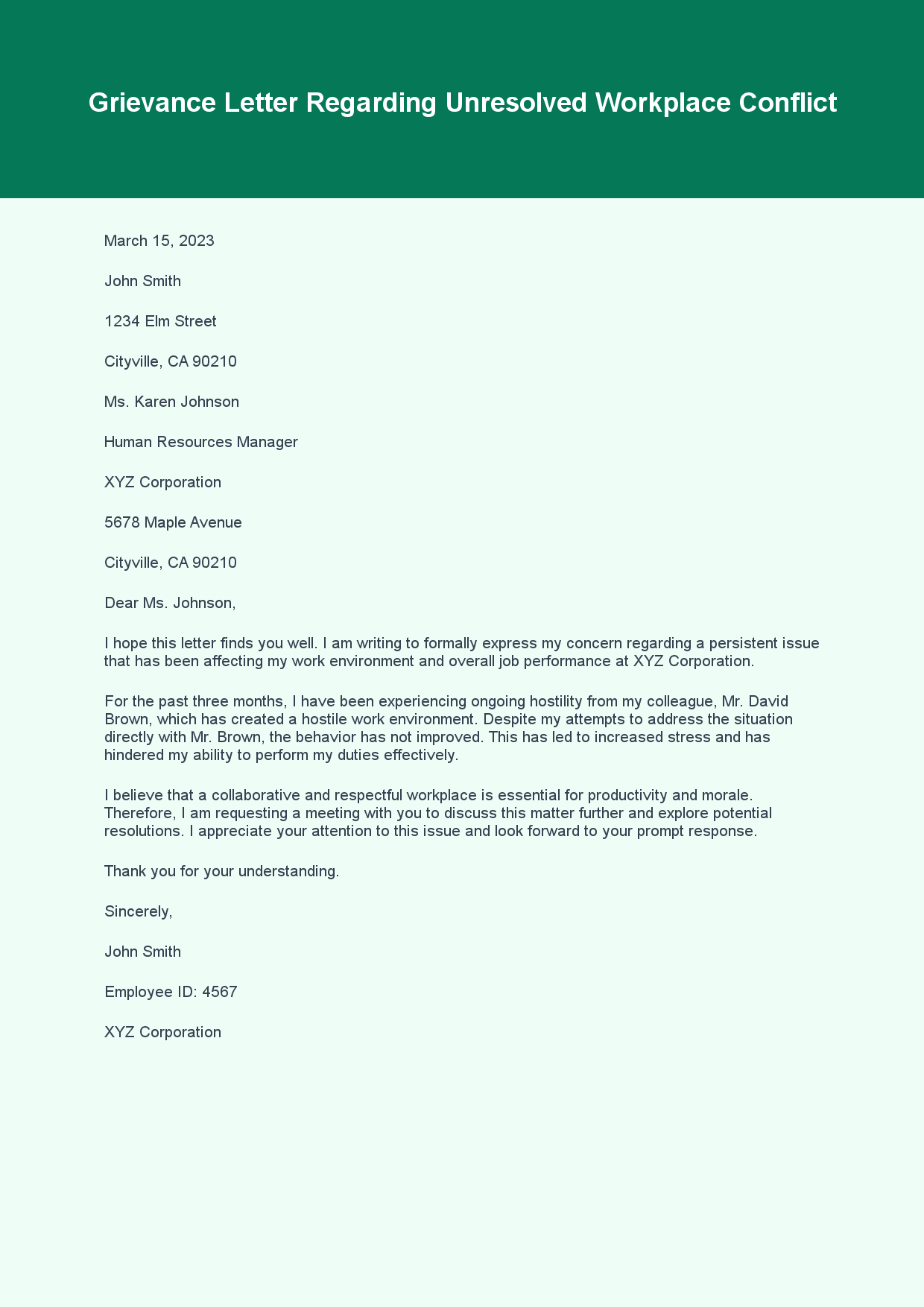
A Grievance Letter for Workplace Issues is a formal document used by employees to express concerns or complaints about workplace conditions, policies, or behaviors that negatively impact their job satisfaction or performance. This letter serves as a structured way to communicate specific issues, such as harassment, discrimination, or unsafe work environments, and requests a resolution or action from management.
In writing a grievance letter, it is essential to clearly outline the problem, provide relevant details and examples, and suggest possible solutions. This not only helps in addressing the issue but also demonstrates the employee's commitment to improving the workplace environment. Properly documenting grievances can facilitate constructive dialogue and lead to positive changes within the organization.
Purpose & Importance of Grievance Letter for Workplace Issue
A Grievance Letter for Workplace Issues serves to formally address and document concerns regarding workplace conditions, behaviors, or policies that negatively impact an employee's work experience.
- Clear Description: Provide a detailed account of the issue, including dates, locations, and individuals involved.
- Impact Assessment: Explain how the issue affects your work performance, mental health, or overall job satisfaction.
- Desired Resolution: Specify what outcome you are seeking, such as changes in policy or actions to rectify the situation.
- Supporting Evidence: Attach any relevant documentation or witness statements that support your claims.
- Follow-Up Request: Indicate your expectation for a response and a timeline for when you would like to hear back.
When Should You Write a Grievance Letter for Workplace Issue ?
- Unfair Treatment - When an employee feels they have been treated unfairly compared to their colleagues, such as in matters of workload, recognition, or support, a grievance letter can formally address these concerns to management.
- Harassment or Bullying - If an employee experiences harassment or bullying from colleagues or superiors, documenting these incidents in a grievance letter is essential for seeking resolution and ensuring a safe workplace.
- Discrimination - An employee who believes they have faced discrimination based on race, gender, age, or any protected characteristic should write a grievance letter to report the issue and seek redress.
- Unsafe Working Conditions - When an employee identifies hazards or unsafe practices in the workplace that compromise health and safety, a grievance letter can prompt action from management to address these issues.
- Violation of Company Policy - If an employee observes violations of company policies by others that affect their work environment or rights, writing a grievance letter can formally alert management to enforce compliance.
- Retaliation - When an employee experiences retaliation for reporting misconduct or participating in investigations, a grievance letter serves to document the actions taken against them and seek protection from further retaliation.
- Inadequate Response to Previous Complaints - If prior complaints have been made without appropriate resolution, a grievance letter can emphasize the lack of action taken and demand accountability from management.
- Workplace Conflict - When interpersonal conflicts with colleagues hinder productivity and morale, a grievance letter can provide a structured way to request mediation or intervention from HR.
- Unreasonable Workload - An employee facing an excessive workload that impacts their mental and physical health may write a grievance letter to seek adjustments and support from their supervisors.
Format of a Grievance Letter for Workplace Issue
A grievance letter is an important tool for addressing workplace issues effectively and formally. This structured outline will guide you in crafting a comprehensive grievance letter that clearly communicates your concerns.
-
Sender's Information
Begin your letter with your name, job title, department, and contact details at the top. This provides the recipient with the necessary information to identify you quickly.
-
Date
Include the date when you are writing the letter. This helps establish a timeline for the grievance and is crucial for record-keeping.
-
Recipient's Information
Next, address the letter to the appropriate person, such as your direct supervisor, HR manager, or the designated grievance officer. Include their name, title, and company address.
-
Subject Line
Add a clear subject line that states the purpose of the letter, such as "Grievance Regarding [Specific Issue]." This allows the recipient to understand the matter at a glance.
-
Opening Statement
Start with a brief introduction that outlines the purpose of your letter. State that you are writing to formally raise a grievance regarding a specific issue.
-
Details of the Grievance
Provide a detailed account of the issue, including dates, times, locations, and any individuals involved. Be factual and objective, avoiding emotional language to keep the focus on the issue at hand.
-
Impact of the Issue
Explain how the issue has affected you, your work, and the workplace environment. This may include stress, decreased productivity, or negative impacts on team dynamics.
-
Previous Attempts to Resolve
If applicable, mention any informal attempts you have made to resolve the issue, including discussions with colleagues or supervisors. This shows your willingness to address the matter amicably.
-
Desired Outcome
Clearly state what you hope to achieve by submitting this grievance. Whether seeking an investigation, a meeting, or a specific resolution, be explicit about your expectations.
-
Closing Statement
Thank the recipient for their attention to this matter. Invite them to contact you for further discussion and express your hope for a prompt resolution.
-
Signature
Conclude with your signature (if sending a hard copy) and your typed name. This adds a personal touch and formalizes the letter.
Sample Grievance Letter for Workplace Issue
Explore five complete scenarios with fully written letters you can adapt immediately.
Grievance Letter for Workplace Issue - Sample 1
Employee facing ongoing hostility from a coworker affecting performance.
March 15, 2023
John Smith
1234 Elm Street
Cityville, CA 90210
Ms. Karen Johnson
Human Resources Manager
XYZ Corporation
5678 Maple Avenue
Cityville, CA 90210
Dear Ms. Johnson,
I hope this letter finds you well. I am writing to formally express my concern regarding a persistent issue that has been affecting my work environment and overall job performance at XYZ Corporation.
For the past three months, I have been experiencing ongoing hostility from my colleague, Mr. David Brown, which has created a hostile work environment. Despite my attempts to address the situation directly with Mr. Brown, the behavior has not improved. This has led to increased stress and has hindered my ability to perform my duties effectively.
I believe that a collaborative and respectful workplace is essential for productivity and morale. Therefore, I am requesting a meeting with you to discuss this matter further and explore potential resolutions. I appreciate your attention to this issue and look forward to your prompt response.
Thank you for your understanding.
Sincerely,
John Smith
Employee ID: 4567
XYZ Corporation
John Smith
1234 Elm Street
Cityville, CA 90210
Ms. Karen Johnson
Human Resources Manager
XYZ Corporation
5678 Maple Avenue
Cityville, CA 90210
Dear Ms. Johnson,
I hope this letter finds you well. I am writing to formally express my concern regarding a persistent issue that has been affecting my work environment and overall job performance at XYZ Corporation.
For the past three months, I have been experiencing ongoing hostility from my colleague, Mr. David Brown, which has created a hostile work environment. Despite my attempts to address the situation directly with Mr. Brown, the behavior has not improved. This has led to increased stress and has hindered my ability to perform my duties effectively.
I believe that a collaborative and respectful workplace is essential for productivity and morale. Therefore, I am requesting a meeting with you to discuss this matter further and explore potential resolutions. I appreciate your attention to this issue and look forward to your prompt response.
Thank you for your understanding.
Sincerely,
John Smith
Employee ID: 4567
XYZ Corporation
Download this letter in:
Grievance Letter for Workplace Issue - Sample 2
Employee reports repeated instances of inappropriate comments from a colleague.
March 15, 2023
Jordan Smith
123 Elm Street
Springfield, IL 62701
Human Resources Department
Tech Innovations Inc.
456 Maple Avenue
Springfield, IL 62702
Dear HR Manager,
I am writing to formally express my concern regarding a series of incidents that I believe constitute harassment in the workplace. Over the past month, I have encountered repeated inappropriate comments from my colleague, Alex Johnson, which I find both distressing and disruptive to my work environment.
Despite my attempts to address these comments directly with Alex, the behavior has not changed. On several occasions, Alex has made remarks about my appearance and personal life that I consider unprofessional and offensive. I have documented these incidents, and they have created a hostile work atmosphere for me, impacting my ability to perform my job effectively.
I urge the HR department to investigate this matter thoroughly and take appropriate action. It is essential for me and my colleagues to work in an environment free from harassment and discrimination. I appreciate your attention to this serious issue and look forward to your prompt response.
Thank you for your understanding.
Sincerely,
Jordan Smith
Marketing Specialist
Tech Innovations Inc.
Jordan Smith
123 Elm Street
Springfield, IL 62701
Human Resources Department
Tech Innovations Inc.
456 Maple Avenue
Springfield, IL 62702
Dear HR Manager,
I am writing to formally express my concern regarding a series of incidents that I believe constitute harassment in the workplace. Over the past month, I have encountered repeated inappropriate comments from my colleague, Alex Johnson, which I find both distressing and disruptive to my work environment.
Despite my attempts to address these comments directly with Alex, the behavior has not changed. On several occasions, Alex has made remarks about my appearance and personal life that I consider unprofessional and offensive. I have documented these incidents, and they have created a hostile work atmosphere for me, impacting my ability to perform my job effectively.
I urge the HR department to investigate this matter thoroughly and take appropriate action. It is essential for me and my colleagues to work in an environment free from harassment and discrimination. I appreciate your attention to this serious issue and look forward to your prompt response.
Thank you for your understanding.
Sincerely,
Jordan Smith
Marketing Specialist
Tech Innovations Inc.
Download this letter in:
Grievance Letter for Workplace Issue - Sample 3
Employee filing a grievance about repeated inappropriate comments from a colleague.
March 15, 2023
Human Resources Department
Tech Solutions Inc.
123 Innovation Drive
San Francisco, CA 94107
Dear Human Resources Manager,
I am writing to formally express my grievance regarding a series of inappropriate comments and behaviors I have experienced from my colleague, John Smith, over the past several months. Despite my efforts to address the situation informally, I feel it is necessary to escalate this matter to ensure a safe and respectful work environment.
On multiple occasions, John has made remarks that I found inappropriate and uncomfortable, including comments about my appearance and personal life during team meetings. These incidents have not only affected my ability to focus on my work but have also created an uncomfortable atmosphere within our team. I have documented these occurrences and can provide specific instances if required.
I believe it is crucial for Tech Solutions Inc. to uphold a professional and respectful workplace for all employees. I would appreciate your prompt attention to this matter and look forward to discussing it further. Thank you for your understanding and support in addressing this issue.
Sincerely,
Emily Johnson
Software Developer
Tech Solutions Inc.
[email protected]
(555) 123-4567
Human Resources Department
Tech Solutions Inc.
123 Innovation Drive
San Francisco, CA 94107
Dear Human Resources Manager,
I am writing to formally express my grievance regarding a series of inappropriate comments and behaviors I have experienced from my colleague, John Smith, over the past several months. Despite my efforts to address the situation informally, I feel it is necessary to escalate this matter to ensure a safe and respectful work environment.
On multiple occasions, John has made remarks that I found inappropriate and uncomfortable, including comments about my appearance and personal life during team meetings. These incidents have not only affected my ability to focus on my work but have also created an uncomfortable atmosphere within our team. I have documented these occurrences and can provide specific instances if required.
I believe it is crucial for Tech Solutions Inc. to uphold a professional and respectful workplace for all employees. I would appreciate your prompt attention to this matter and look forward to discussing it further. Thank you for your understanding and support in addressing this issue.
Sincerely,
Emily Johnson
Software Developer
Tech Solutions Inc.
[email protected]
(555) 123-4567
Download this letter in:
Grievance Letter for Workplace Issue - Sample 4
Employee experiencing ongoing harassment from a colleague.
October 5, 2023
Jessica Taylor
1234 Elm Street
Springfield, IL 62701
Human Resources Department
Alpha Solutions Inc.
5678 Oak Avenue
Springfield, IL 62701
Dear HR Manager,
I am writing to formally address a grievance regarding a workplace issue that has been affecting my ability to perform my job effectively. Over the past three months, I have experienced ongoing harassment from my colleague, John Smith, who works in the marketing department.
Despite my efforts to address his behavior directly, which included several conversations requesting that he respect my personal boundaries, the situation has not improved. John frequently makes inappropriate comments about my appearance and has engaged in unwanted physical contact, which has made me feel uncomfortable and unsafe in my work environment.
I believe that the company has a responsibility to provide a safe and respectful workplace for all employees. I request that this matter be investigated promptly and that appropriate action be taken to ensure that such behavior does not continue. I am willing to discuss this matter further and provide any additional information necessary.
Thank you for your attention to this serious matter. I look forward to your prompt response.
Sincerely,
Jessica Taylor
Jessica Taylor
1234 Elm Street
Springfield, IL 62701
Human Resources Department
Alpha Solutions Inc.
5678 Oak Avenue
Springfield, IL 62701
Dear HR Manager,
I am writing to formally address a grievance regarding a workplace issue that has been affecting my ability to perform my job effectively. Over the past three months, I have experienced ongoing harassment from my colleague, John Smith, who works in the marketing department.
Despite my efforts to address his behavior directly, which included several conversations requesting that he respect my personal boundaries, the situation has not improved. John frequently makes inappropriate comments about my appearance and has engaged in unwanted physical contact, which has made me feel uncomfortable and unsafe in my work environment.
I believe that the company has a responsibility to provide a safe and respectful workplace for all employees. I request that this matter be investigated promptly and that appropriate action be taken to ensure that such behavior does not continue. I am willing to discuss this matter further and provide any additional information necessary.
Thank you for your attention to this serious matter. I look forward to your prompt response.
Sincerely,
Jessica Taylor
Download this letter in:
Grievance Letter for Workplace Issue - Sample 5
An employee raises concerns about ongoing harassment by a colleague that remains unaddressed.
October 15, 2023
Human Resources Department
Acme Corporation
123 Business Rd.
Suite 456
Metropolis, NY 10001
Dear Human Resources Manager,
I am writing to formally lodge a grievance regarding a workplace issue that has become increasingly distressing and disruptive to my work environment. I have been experiencing ongoing harassment from a colleague, Mr. John Smith, in the Marketing Department, which has yet to be adequately addressed despite my previous informal complaints.
Since early September, Mr. Smith has made several inappropriate comments and gestures towards me that have created a hostile work atmosphere. I have attempted to resolve this issue directly with him, but his behavior has not changed. I initially brought this matter to my supervisor's attention on September 20, 2023, but there has been no follow-up or action taken to rectify the situation.
I believe that a safe and respectful workplace is fundamental to our company’s values, and I am requesting a formal investigation into my claims. I am hopeful that the Human Resources department can provide the necessary support to address this grievance promptly and effectively.
Thank you for your attention to this serious matter. I look forward to your prompt response.
Sincerely,
Emily Johnson
Marketing Specialist
Acme Corporation
[email protected]
(555) 123-4567
Human Resources Department
Acme Corporation
123 Business Rd.
Suite 456
Metropolis, NY 10001
Dear Human Resources Manager,
I am writing to formally lodge a grievance regarding a workplace issue that has become increasingly distressing and disruptive to my work environment. I have been experiencing ongoing harassment from a colleague, Mr. John Smith, in the Marketing Department, which has yet to be adequately addressed despite my previous informal complaints.
Since early September, Mr. Smith has made several inappropriate comments and gestures towards me that have created a hostile work atmosphere. I have attempted to resolve this issue directly with him, but his behavior has not changed. I initially brought this matter to my supervisor's attention on September 20, 2023, but there has been no follow-up or action taken to rectify the situation.
I believe that a safe and respectful workplace is fundamental to our company’s values, and I am requesting a formal investigation into my claims. I am hopeful that the Human Resources department can provide the necessary support to address this grievance promptly and effectively.
Thank you for your attention to this serious matter. I look forward to your prompt response.
Sincerely,
Emily Johnson
Marketing Specialist
Acme Corporation
[email protected]
(555) 123-4567
Download this letter in:
Tips to Write an Effective Grievance Letter for Workplace Issue
- Be Clear: State the issue directly and unambiguously.
- Stay Professional: Maintain a respectful tone, even if you're upset.
- Use Specific Examples: Support your claims with concrete incidents and details.
- Focus on Facts: Stick to objective information rather than personal feelings.
- Outline Desired Outcomes: Clearly specify what resolution you seek.
- Keep it Concise: Aim for brevity; a one-page letter is often sufficient.
- Use Formal Language: Avoid slang and casual phrases to maintain professionalism.
- Organize Logically: Follow a clear structure—introduction, body, conclusion.
- Proofread: Check for spelling and grammar errors to enhance credibility.
- Include Relevant Dates: Mention when the incidents occurred for context.
- Address the Right Person: Send your letter to the appropriate management or HR personnel.
- Keep Copies: Save a copy of your letter for your records.
- Be Honest: Present your grievances truthfully without exaggeration.
- Follow Company Protocol: Familiarize yourself with your organization’s grievance procedures.
- Request a Follow-Up: Politely ask for confirmation of receipt and a timeline for response.
Common Mistakes to Avoid in Grievance Letter for Workplace Issue
- Lack of Clarity - Failing to clearly state the issue at hand can lead to misunderstandings and a lack of action. It's important to be specific about what the grievance is.
- Emotional Language - Using overly emotional or inflammatory language can detract from the seriousness of the grievance and may cause the letter to be dismissed. Maintaining a professional tone is crucial.
- Vagueness - Not providing specific details, such as dates, times, and witnesses, can weaken the case presented in the letter. Specificity helps in substantiating the grievance.
- Failure to Follow Company Policy - Ignoring established procedures for filing grievances can result in the letter being disregarded. Always adhere to the organization's guidelines.
- Lack of Evidence - Not including supporting documentation or evidence can undermine the credibility of the grievance. Attach relevant emails, reports, or witness statements to bolster the case.
- Not Suggesting a Resolution - Failing to propose a potential solution or outcome can leave the reader unsure of how to proceed. Clearly stating what you hope to achieve can facilitate a constructive response.
- Neglecting to Proofread - Spelling and grammatical errors can detract from the professionalism of the letter. Taking the time to proofread ensures clarity and credibility.
- Being Confrontational - Adopting a confrontational tone can create defensiveness and hinder resolution. A collaborative approach is more likely to lead to a positive outcome.
Subject Line Examples for Grievance Letter for Workplace Issue
- Addressing your workplace concerns: Our grievance process explained
- Your grievance letter: Next steps in resolving workplace issues
- Understanding the grievance process for workplace complaints
- We hear you: Acknowledging your grievance letter
- Taking action on your grievance: What to expect
- How to effectively communicate your workplace grievances
- Seeking resolution: Your grievance letter matters
- Navigating workplace issues: Your grievance rights
- Steps to address your workplace grievance effectively
- Empowering your voice: The importance of grievance letters
- Resolving workplace conflicts: The role of grievance letters
- Grievance letters: A guide to expressing your workplace concerns
- Your concerns matter: Initiating the grievance process
- Understanding the impact of your grievance letter
- From grievance to resolution: Our commitment to you
- Taking the first step: Writing an effective grievance letter
Useful Phrases & Lines for Grievance Letter for Workplace Issue
Opening Lines
- I am writing to formally raise a grievance regarding a workplace issue that has been affecting my performance and well-being.
- This letter serves to express my concerns regarding [specific issue] that I have encountered in the workplace.
- I wish to bring to your attention a matter that I believe requires urgent attention and resolution.
- It is with a heavy heart that I submit this grievance, as I value our workplace and the team we have built.
Body Lines
- On [specific date], I experienced [describe the incident or issue] which has led to ongoing challenges in my role.
- Despite my efforts to address this matter informally with [name or position of person involved], it remains unresolved.
- I believe this situation violates [mention any relevant company policies or codes of conduct], impacting not only my work but also the team's morale.
- I have taken the following steps to address the issue: [list any actions you've taken, such as discussions with HR, team meetings, etc.].
- I would appreciate it if you could look into this matter promptly and provide guidance on the next steps for resolution.
Closing Lines
- Thank you for your attention to this serious matter; I look forward to your prompt response.
- I hope we can resolve this issue amicably and restore a positive working environment.
- Please let me know a convenient time for us to discuss this further.
- I appreciate your understanding and support as we work towards a resolution.
FAQs about Grievance Letter for Workplace Issue
- What is a grievance letter?
A grievance letter is a formal written complaint submitted by an employee to address workplace issues such as harassment, discrimination, or unsafe working conditions. It aims to document concerns and initiate a resolution process through appropriate channels within the organization.
- When should I write a grievance letter?
You should write a grievance letter when informal discussions about a workplace issue have not resolved the problem. If the issue persists and affects your work environment or well-being, a formal letter is appropriate to escalate the matter to management or HR.
- What should I include in a grievance letter?
Your grievance letter should include your contact information, a clear description of the issue, relevant dates, any witnesses, and the impact on your work life. It’s also helpful to suggest potential solutions or outcomes you would like to see.
- How long should a grievance letter be?
A grievance letter should be concise and focused, typically one to two pages long. Aim to be clear and direct while providing enough context for management to understand the issue without overwhelming them with excessive details.
- Is there a specific format for a grievance letter?
While there is no strict format, a grievance letter generally includes a heading with your information, the date, recipient's information, a subject line, a salutation, body paragraphs detailing the grievance, and a closing with your signature. Maintain a professional tone throughout.
- What happens after I submit a grievance letter?
After submitting a grievance letter, the management or HR department will typically acknowledge receipt and may investigate the issue. They may arrange a meeting to discuss your concerns and seek a resolution, ensuring to follow the organization’s grievance procedures.
In conclusion, taking the time to craft a thoughtful and well-structured Grievance Letter is an essential step towards addressing workplace issues effectively. By following the guidance provided, you empower yourself to communicate your concerns clearly and professionally, fostering a constructive dialogue with your employer. Remember, advocating for your rights not only benefits you but also contributes to a healthier workplace environment for everyone. We encourage you to take action today and transform your grievances into positive change.